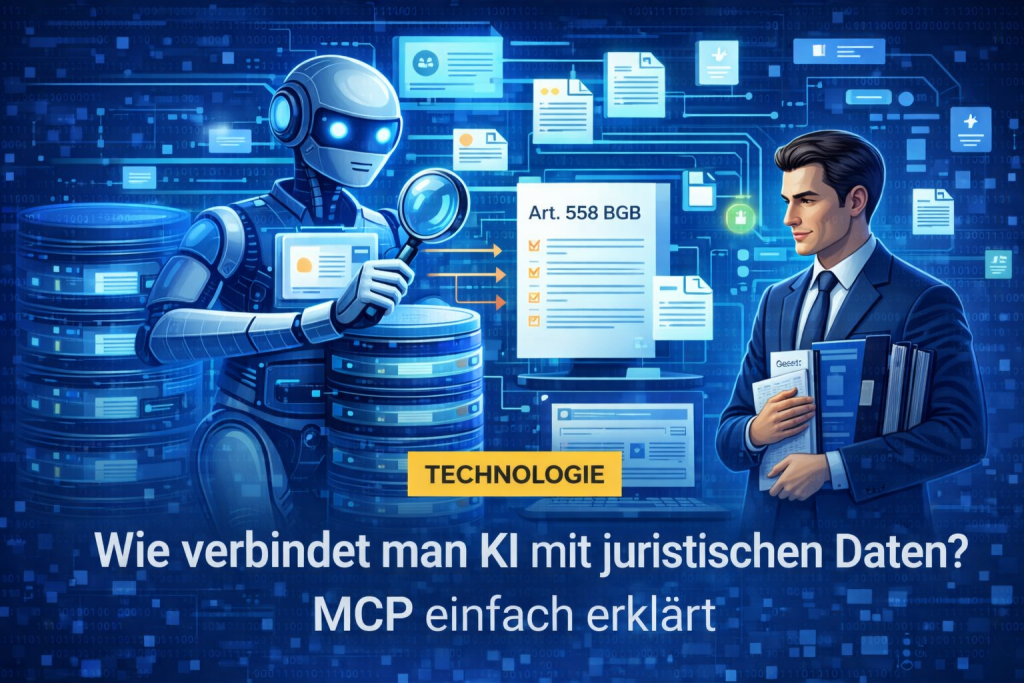
Artificial intelligence can answer legal questions. But without access to verified data, it remains unreliable.
The key question is therefore not: “Which AI am I using?”
But rather: “How do I connect AI with reliable legal data?”
The answer lies in the architecture.
More specifically: in the Model Context Protocol (MCP).
MCP doesn’t simply connect AI to data – it controls when and how that data is incorporated into the response.
Briefly explained
- AI on its own works with training data
- Reliable answers require up-to-date, verified sources
- MCP connects AI to these data sources in a targeted way
MCP is the technical foundation for grounding.
The core problem
Language models such as ChatGPT, Claude, or Copilot:
- do not actively access external data
- do not verify sources
- are not aware of current legal developments
The result:
- incorrect or outdated statements
- lack of traceability
- high manual verification effort
The key message: Without data connectivity, AI remains error-prone in a legal context.
What does “connecting AI with data” actually mean?
Many people imagine it like this: you “upload data” and the AI then knows it. That falls short.
In practice, it comes down to three things:
- access to structured content
- contextual understanding (semantic search)
- targeted integration into the response
It’s not enough to provide data – it must be actively incorporated into the answer.
What is MCP (Model Context Protocol)?
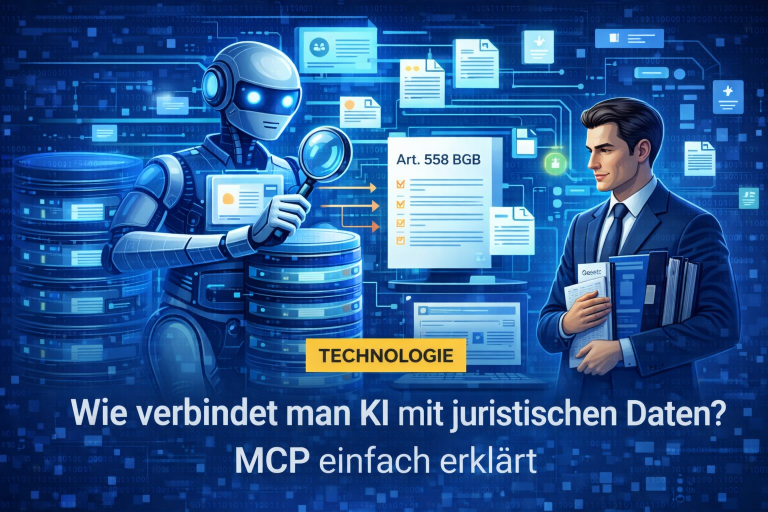
Definition: MCP is a protocol that defines how AI systems interact with external data sources and tools.
Or more simply: MCP is the interface between AI and data.
How MCP works
MCP ensures that the AI:
- receives a query
- identifies which information is missing
- retrieves relevant external data in a targeted way
- integrates that data into the response
The AI no longer decides only based on what sounds plausible – it works deliberately with external knowledge.
This means: The AI no longer operates in isolation, but is embedded within a system of data sources.
A concrete example
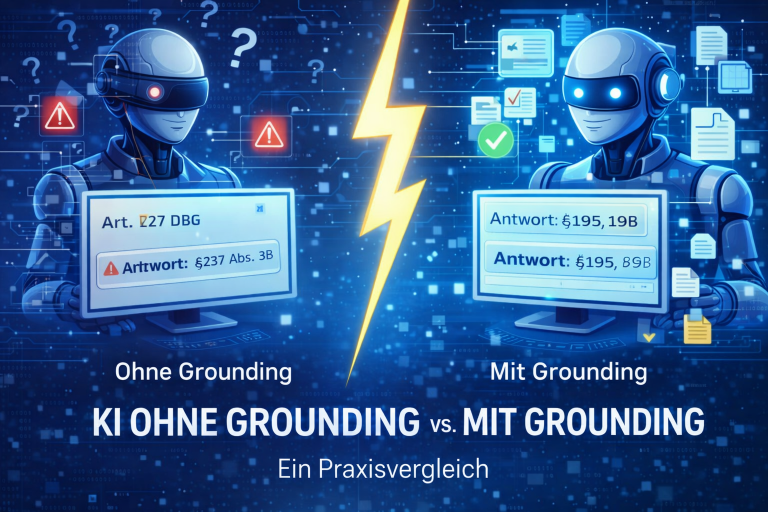
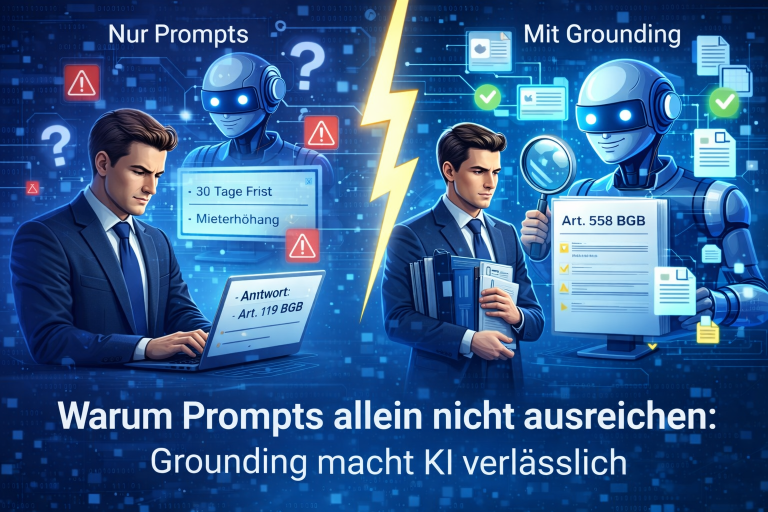
Without MCP
Question:
“What is the deadline for a GDPR access request?”
Answer:
“Usually 30 days.”
The problem:
- imprecise
- no source
- not reliable
With MCP
Question:
“What is the deadline for a GDPR access request?”
Process:
- the AI recognizes: legal question
- MCP accesses legal data
- the relevant provision is retrieved
Answer:
“According to Art. 12(3) GDPR, the deadline is one month…”
Result:
- correct
- traceable
- verifiable
Why MCP is so crucial
MCP doesn’t change the AI – it changes its access to knowledge. That’s the key difference. The difference lies not in the model, but in the connection.
MCP vs. traditional approaches (e.g. RAG)
Many people are familiar with the term RAG (Retrieval Augmented Generation).
MCP goes one step further:
| RAG | MCP |
| retrieves data from a source | controls access to my systems |
| often statically integrated | flexibly integrable |
| focus on content | focus on architecture |
| limited control | enables targeted interaction |
What companies actually need
To connect AI with legal data, you need:
- structured legal sources
- semantic processing
- an interface to the AI (e.g. MCP)
Reliable AI is not created by the model – but by the integration.
Example: PLANIT // LAWBSTER
PLANIT // LAWBSTER is a specially developed MCP server that connects AI systems such as ChatGPT, Claude, or Copilot directly with legal data.
Classification:
PLANIT // LAWBSTER is not an AI system in itself. It is the infrastructure that extends existing AI systems.
The key difference:
PLANIT // LAWBSTER not only provides data – it makes that data legally structured and semantically searchable so it can be used effectively by AI.
This means:
- access to verified legal contentvlex
- structured and semantic searchgithub
- traceable answers with sources
Your AI is not replaced – it is made reliably usable for the first time
How // LAWBSTER is used in practice
Typical flow:
- The user asks a question (e.g. in ChatGPT)
- MCP detects the context
- Relevant legal data is retrieved
- The answer is generated on a solid basis
Optional:
- Integration of internal knowledge bases (RAG)
- Combination of external law + company knowledge
Why this approach is scalable
The advantage of MCP:
- Works with existing AI systems
- Does not require a new tool
- Can be extended flexibly
AI is not replaced – it is integrated.
What this means for companies
The crucial question is not: “Which AI is the best?”
But rather: “How is our AI connected to data?”
In short
- AI on its own is not reliable
- Data is necessary – but not sufficient
- What really matters is the connection between the two
- MCP is the technical foundation for this
Only with MCP does grounding become practically usable.
Would you like to see how this works in practice?
Test PLANIT // LAWBSTER free for 14 days.
Frequently Asked Questions (FAQ)
What is MCP in simple terms?
MCP is an interface that allows AI systems to access external data sources in a targeted way.
Why do you need MCP?
Because AI cannot provide reliable information without being connected to relevant data sources.
What is the difference between MCP and RAG?
RAG provides data, while MCP controls how AI accesses and uses that data.
Can MCP be added later?
Yes. Existing AI systems can be extended via MCP.